
Prompt Improvement
Enhance your initial prompt using Mazar.ai and create exceptional content.
How to improve your prompt to get the best out of Mazar.ai
-
Simply write you initail prompt in the Editor
-
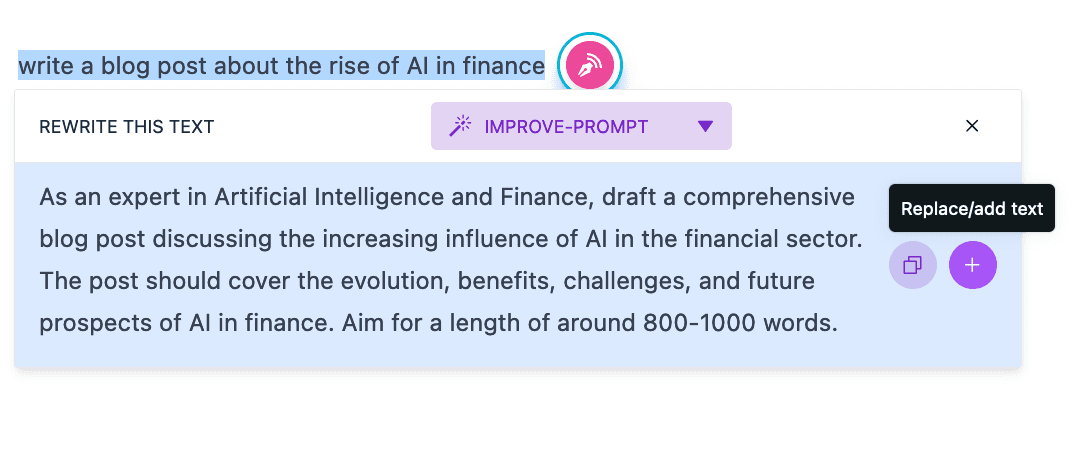
Select your initial prompt and Click the the Improve Prompt button

-
Mazar.ai will generate an improved prompt for you
-
Click the Add/Copy button and add it to the Editor
-
Edit the generated prompt to your liking
-
Select you prompt and click on the Ask button to generate
Generated blog post
Generated by Mazar.ai
The Rise of AI in Finance
Artificial Intelligence (AI) has become an integral part of many industries, including finance. The advancements in AI technology have opened up a world of possibilities for financial institutions, allowing them to automate processes, analyze vast amounts of data, and provide personalized services to their customers. In this blog post, we will explore the rise of AI in finance and its implications for the industry.
Automating Processes
One of the main advantages of AI in finance is its ability to automate repetitive and time-consuming processes. Tasks such as data entry, transaction processing, and risk assessment can now be handled by intelligent algorithms, freeing up human resources to focus on more complex and strategic activities. This not only increases productivity but also reduces the chances of errors and improves efficiency.
Data Analysis and Predictive Analytics
AI has revolutionized data analysis in the finance industry. With the help of machine learning algorithms, financial institutions can now analyze vast amounts of data in real-time, identifying patterns and trends that were previously difficult to uncover. This enables them to make more informed decisions, manage risks effectively, and detect fraud more efficiently. Moreover, AI-powered predictive analytics can be used to forecast market trends, identify investment opportunities, and optimize portfolio management.
Personalized Services and Customer Experience
AI has transformed the way financial institutions interact with their customers. By leveraging AI technology, they can now offer personalized services tailored to individual needs. Chatbots and virtual assistants powered by natural language processing can provide customers with instant support, answer their queries, and assist in financial planning. AI algorithms can analyze customers' financial data and offer customized investment advice or suggest appropriate financial products. This not only enhances the customer experience but also improves customer engagement and loyalty.
Robo-Advisors and Algorithmic Trading
Another area where AI has made significant strides in finance is in the field of investment management. Robo-advisors, powered by AI algorithms, provide low-cost investment advice and portfolio management services to individual investors. They utilize machine learning to assess risk tolerance, investment goals, and market conditions, offering personalized investment plans. Similarly, algorithms are extensively used in algorithmic trading, where computers execute trades based on pre-defined rules and analyze market data to identify profitable opportunities in a fraction of a second.
Challenges and Ethical Considerations
While the rise of AI in finance brings numerous benefits, there are also challenges and ethical considerations that need to be addressed. The increased reliance on AI raises concerns about data privacy and security. Financial institutions must ensure that the data they collect is handled securely and in compliance with regulations. Additionally, the adoption of AI may lead to job displacement in some areas of the finance industry. It is crucial for organizations to upskill and reskill their workforce to adapt to the changing landscape.
Conclusion
The rise of AI in finance has transformed the industry, allowing financial institutions to automate processes, analyze data more effectively, and provide personalized services to customers. However, it is important to strike a balance between leveraging AI's capabilities and addressing the associated challenges. By doing so, the finance industry can harness the power of AI to drive innovation, improve operational efficiency, and deliver superior customer experiences.